Radial Access to Vocabulary in AAC: Decoupling Automaticity From Motor Plans
December 10, 2025.
Abstract
Automaticity in augmentative and alternative communication (AAC) has historically been defined through stable motor plans and linear navigation pathways. This association emerged largely from early technical constraints in AAC system design rather than from how language is cognitively processed. As a result, fluency and competence in AAC are often interpreted through movement efficiency instead of meaning construction.
This preprint introduces radial access to vocabulary as a complementary access model that decouples automaticity from motor memory. In radial access, a word or concept functions as a semantic anchor from which related vocabulary becomes dynamically available through non-linear, associative pathways. Rather than replacing established motor plans, radial access coexists with them, offering an additional route to sentence-level fluency grounded in semantic association.
The concept reframes automaticity as the efficiency of assembling meaning at the sentence level, aligning AAC access more closely with spoken language cognition. It further argues that current AAC architectures—characterized by hierarchical folders, static grids, and linear prediction—mirror typing more than thinking, which may obscure competence for certain users, including multilingual communicators, gestalt language processors, and individuals with strong conceptual knowledge but limited literacy or variable motor access.
This preprint serves as an authorship record and conceptual foundation for ongoing scholarly work. A formal Viewpoint manuscript expanding this framework is currently in preparation.
Background and Rationale
AAC systems have long relied on motor planning to support fluency and speed. This reliance has been effective and remains essential for many users. However, the field has often treated motor memory as synonymous with automaticity, overlooking alternative cognitive pathways to fluent language generation.
In spoken language, automaticity does not depend on repeated physical movement. Instead, it emerges from associative networks of meaning, intention, and context. When AAC access pathways prioritize navigation sequences over semantic relationships, they risk misaligning with how language is processed cognitively.
Defining Radial Access to Vocabulary
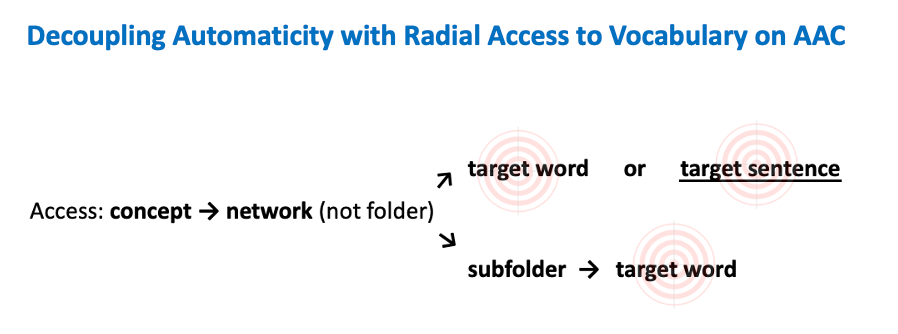
Radial access refers to a vocabulary access model in which a word or concept serves as a central semantic anchor. From this anchor, related vocabulary becomes available through non-linear, associative pathways rather than fixed hierarchical navigation.
Key characteristics of radial access include semantic anchoring rather than category drilling, non-linear expansion of related vocabulary, context-sensitive availability, and optional use alongside stable motor plans.
Automaticity Reframed
This framework proposes that automaticity in AAC should be understood as meaning-level efficiency, not solely motor efficiency. Speed to sentence, rather than speed to word, becomes the relevant outcome.
Linear prediction and category navigation support word retrieval but do not model associative language processing. Radial access supports the assembly of ideas through semantic proximity, offering a cognitively aligned pathway to expression.
Clinical and Design Implications
Radial access may be particularly relevant for multilingual AAC users, gestalt language processors, users with variable motor access or fatigue, and emergent communicators whose competence is underestimated.
Design implications include hybrid interfaces that preserve motor plan stability while enabling semantic expansion through user-controlled, non-linear access.
Authorship and Prior Disclosure
An early description of the concept of radial access to vocabulary was shared publicly by the author on LinkedIn on December 13, 2025, as part of a professional discussion on AAC access models. This preprint establishes a permanent, citable record of authorship and conceptual origin. A peer-reviewed Viewpoint manuscript based on this framework is in preparation for journal submission.
*This design proposal sits within a broader conceptual framework examining automaticity and vocabulary architecture in AAC.