Aligned Literacy Layering
An access-focused framework for embedding literacy within existing tasks
Context: This framework emerges from my work as an assistive technology practitioner in public education. My role sits intentionally at the boundary between access and instruction. I don’t design curriculum or determine instructional goals, but I am fortunate to collaborate with teams that bring me into planning conversations. Aligned Literacy Layering grew from that boundary and documents an access-centered way of making literacy structures visible without altering instructional intent.
Aligned Literacy Layering is an access-focused framework that describes how literacy complexity can be embedded within an existing task without changing the goal or redesigning instruction. I developed this framework through my work as an AT practitioner, where my role is not to determine what is taught, but to design supports that allow students to access instruction that already exists. In practice, I work at the point where access and learning intersect. Teachers bring goals and instructional intent. Students bring their language systems, strengths, and access needs. My responsibility is to design supports that make those goals reachable for the student, while fitting naturally within classroom instruction.
Aligned Literacy Layering emerged from that boundary.
Many students I support, including students who use AAC, demonstrate comprehension before they demonstrate conventional literacy skills. Too often, literacy instruction arrives later, separately, or in ways that require students to abandon the very supports that made comprehension possible. This creates an artificial divide between understanding and language structure.
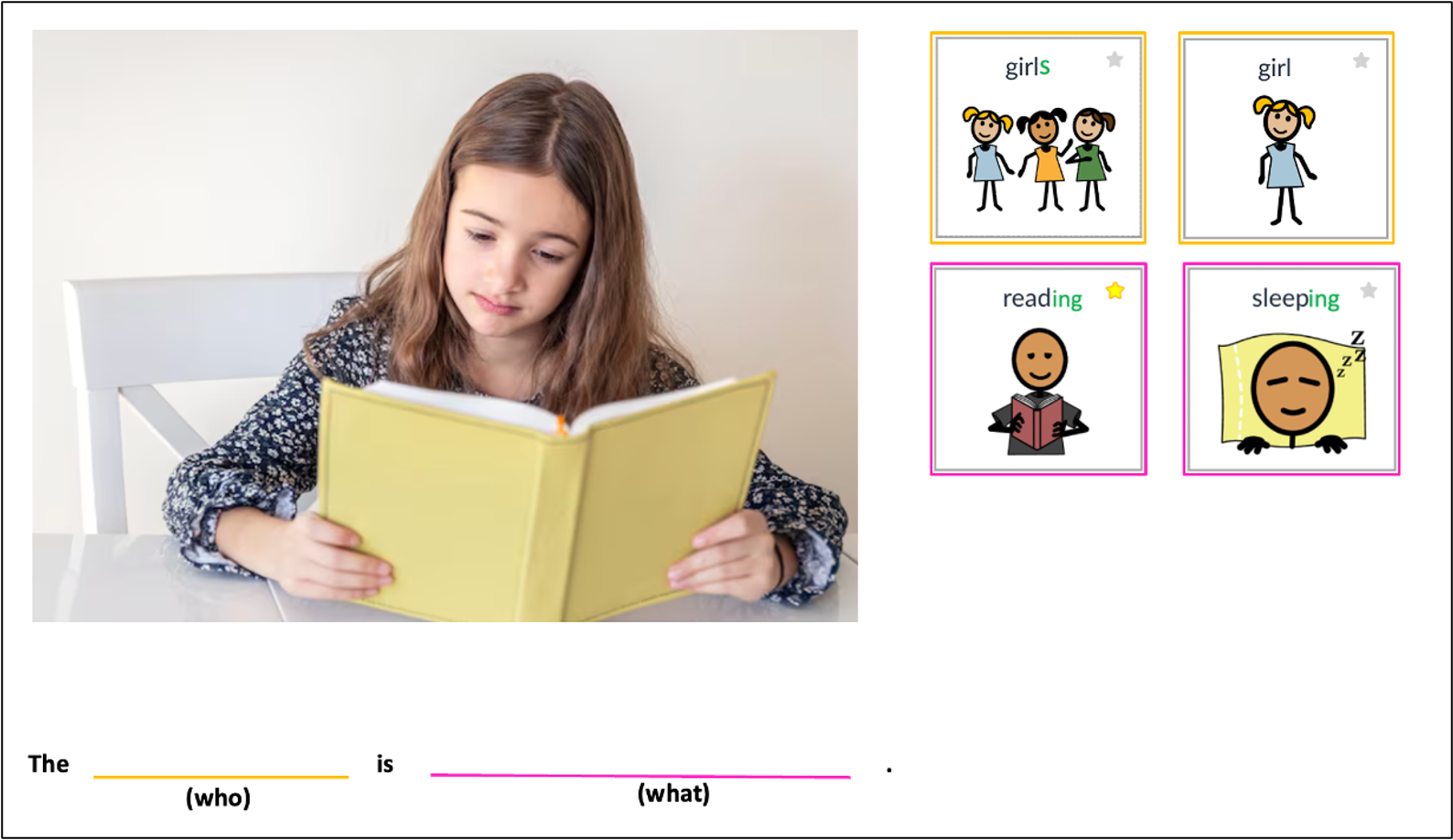
Aligned Literacy Layering starts from a different premise. Literacy develops best when it grows inside meaning the student already understands. In this framework, the task stays the same, and the instructional goal stays the same. What changes is how access is designed. Meaning remains anchored first. The student engages with a stable image, context, or task that clearly conveys what is happening. This anchor does not move as language complexity increases. And because the student does not have to reestablish meaning, cognitive effort can shift toward noticing language. In the example here, the sentence structure remains predictable. The syntactic roles in the task do not change. “Who” stays “who”. “What” stays “what”. Sentence frames remain consistent with the language structures the student already uses, including structures reflected in AAC systems or classroom routines. This consistency reduces translation demands and supports comprehension.
Within that stable semantic and syntactic frame, print-based language features become visible. Base words expand to show plural markers or verb forms; these changes increase linguistic precision without introducing new concepts or new sentence roles. The student does not need to perform or explain these changes. Exposure alone allows patterns to emerge.
When appropriate, instructional materials align visually with the student’s existing access systems. This may include color coding that mirrors AAC word classes, consistent placement of sentence elements, or visual supports that reflect how the student already organizes language. This alignment does not exist to teach symbols. It exists to reduce the cognitive load of moving between systems. Aligned Literacy Layering is access-first, not symbol-first. It works with symbols when symbols support access, and it works without symbols when they do not. The framework does not require icons, nor does it oppose them. It prioritizes alignment over modality.
This approach fits naturally within an MTSS lens: supports scaffold access at the start, fades as independence increases, and allows skills to generalize across tasks. The goal does not change across this process; only the supports evolve. Importantly, Aligned Literacy Layering does not position assistive technology practitioners as curriculum designers. I don’t decide what literacy skills should be taught or when. I design supports that allow students to access the instruction they are already receiving. When I add a layer that makes language structure visible, I do so in service of access, not instruction ownership.
When supports feel complex to the designer but simple to the learner, they are doing their job. Without intentional access design, complexity doesn’t disappear but shifts onto the student. Aligned Literacy Layering keeps that responsibility where it belongs, with the system, not the learner. The supports change, but the goal stays the same. Literacy grows inside real tasks, without breaking comprehension, without destabilizing language systems, and without asking students to choose between access and learning.
January 2, 2025.