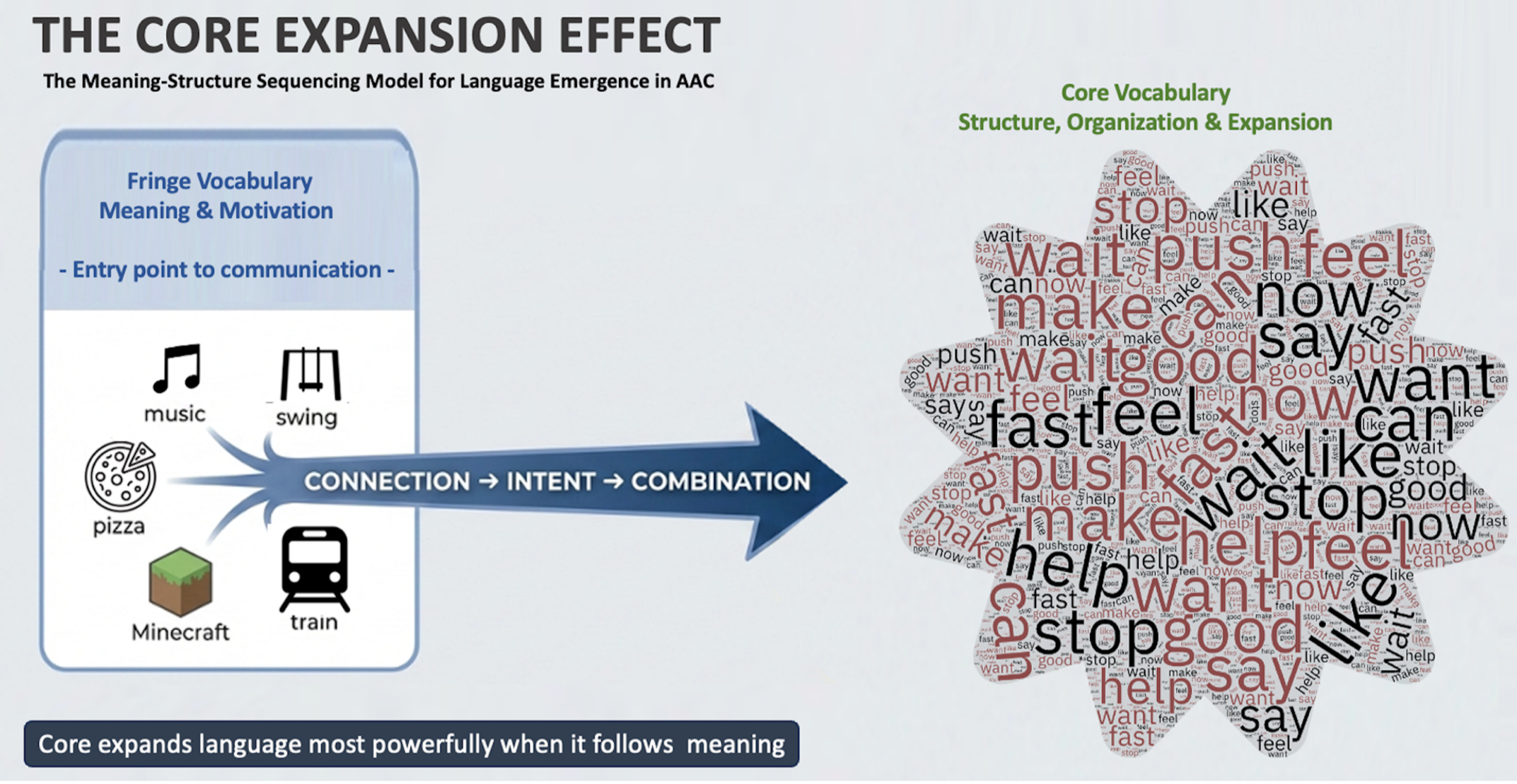
The Core Expansion Effect
Core vocabulary is foundational to augmentative and alternative communication (AAC) systems and supports flexible, generative language. In my practice, however, early communicators frequently demonstrate initial communicative intent through highly salient fringe vocabulary rather than core words. This opinion article introduces the Core Expansion Effect, a conceptual framework proposing that meaningful AAC use often emerges through fringe vocabulary and expands toward core vocabulary as communicative relevance, relational meaning, and intent develop.
Consider these sentences:
“I like that music and want it now because it makes me feel good.”
“Do not stop, I like it when you push me on the swing!”
“You say wait, he says wait, but I want more pizza.”
“I can build it in Minecraft if you help me.”
“The train goes fast when I push it down like this!”
Across these examples, there are five motivating fringe words (music, swing, pizza, Minecraft, train) and twenty-seven unique core words (I, like, that, and, want, it, now, make, me, feel, good, do, not, stop, when, you, more, on, say, he, but, can, help, go, fast, this).
What Statistics Predict, and What Children Do
If I modeled these sentences to emergent communicators, this core set would be expected to statistically dominate output for three reasons. First, it is numerically dominant, with core words representing approximately 84% of the available vocabulary and fringe words approximately 16% percent. Second, AAC systems typically make core vocabulary easier to access. Third, adults tend to cue, prompt, and reinforce core vocabulary more heavily, often treating core usage as a productivity metric, where more core words are equated with more language.
However, in practice with non-speaking students, core vocabulary is often not the natural entry point for early communication. Meaning is. For emergent communicators, meaning is most often carried by motivating fringe words, or by fringe-plus-core pairings, that connect immediately to experience, desire, action, and consequence.
Meaning for an early communicator does not follow statistical logic. Probability reflects the design and pressures of communicative systems, including tools, adult behavior, and expectations, rather than communicative salience at the point of emergence.
Are core vocabulary lists developmental mirrors, or adult abstractions?
Core lists are frequently treated as if they reflect how language naturally begins (Semmler, 2023). In practice, they might resemble adult abstractions of language efficiency more than true developmental mirrors. They prioritize generalizability, portability, and system-level convenience. While these qualities matter deeply to educators and designers, they don’t always align with how language first becomes meaningful for a child. What I often observe instead is that children move toward fringe words first.
Core-First as Systems’ Approaches
Core-first approaches are typically framed as a pedagogical best practice, but they may also reflect broader system constraints. These include grid-based layouts that privilege uniformity over salience, instructional mandates that prioritize measurable outputs, and AAC architectures that are easier to standardize than to personalize.
Grid-based layouts and standardized AAC architectures are not inherently limiting. They provide stable spatial and systemic structures necessary for language mapping and transfer, a concept developed within the author’s broader theoretical work on AAC system organization and motor planning. The critical question is not whether structure should exist, but whether systems allow flexibility in how salience, meaning, and access pathways are permitted to emerge over time.
When systems implicitly or explicitly force core-first behavior, they can become misaligned with how language emerges for some users. In these cases, core words risk becoming compliance artifacts, activated to satisfy instructional expectations rather than recruited as tools for genuine expression.
Reframing the Debate: It’s About Sequence
This reframes the debate. The issue is not whether both core and fringe vocabulary matter. The issue is sequence, and the degree to which system design constrains or enables how that sequence unfolds.
The Core Expansion Effect reframes core and fringe balance as a sequencing and systems problem rather than a vocabulary selection problem. A recurring pattern becomes visible. Fringe vocabulary establishes connections to objects, people, self, time, and consequence. Connection creates intent, as the communicator has something they want to say in the moment. Intent enables combination, allowing words to begin combining naturally. Core vocabulary then expands rapidly, emerging as relational infrastructure that organizes agency, time, causality, contrast, and interaction.
In the five sentences above, five meaningful fringe words generated dense and efficient core usage. Core did not need to be front-loaded. It was recruited once the meaning was already established.
None of this diminishes the importance of core vocabulary. On the contrary, it strengthens its role. Core vocabulary supports generalization across contexts, enables syntactic flexibility, and allows language to scale rapidly. Combining core words accelerates language growth. However, children don’t begin combining words because they are core. They combine words because communication has become meaningful. Meaning is the catalyst that activates combination(s).
Structure remains necessary. Future AAC architectures, including emerging non-linear approaches such as radial access to vocabulary, depend on strong, stable systems that allow language to be mapped, expanded, and reconfigured over time. Yet structure without semantic grounding is fragile. Core vocabulary does not become meaningful through repetition or requirement. It gains relevance when recruited to express something that already matters. Fringe opens the door. Core builds the room.
Implications Beyond the Classroom
This sequencing has implications for design, instruction, and policy. AAC systems must allow meaning to surface before enforcing structure, enabling architectures that map language around lived relevance rather than efficiency alone. Instructional modeling should honor fringe vocabulary as an entry point, trusting that core density will follow. Policy and compliance frameworks should avoid measuring language growth solely by early core usage, and instead consider whether systems enable connection, intent, and expansion.
The importance of meaningful vocabulary in AAC is well recognized (Binger et al., 2024). What has been less clearly articulated is how meaning, sequence, and system architecture interact, and what this interaction implies for design, instruction, and policy. The Core Expansion Effect names and visualizes that relationship. It is not a rejection of core vocabulary, but a reordering grounded in practice, and attentive to how systems shape behavior. Language does not grow because the right words are mandated. It grows because something matters first.
Positioning and Scope
This opinion piece presents The Core Expansion Effect as a conceptual model and theoretical synthesis grounded in applied AAC practice and systems analysis. It does not propose a new instructional protocol, nor does it seek to replace existing evidence-based AAC approaches. Instead, it articulates how meaning, sequencing, and system architecture interact to shape language emergence, particularly for early and emergent communicators. The model integrates observed communicative patterns with design considerations, treating vocabulary not only as linguistic content but also as access infrastructure. Its purpose is to inform interpretation, guide design thinking, and generate future inquiry, rather than to prescribe uniform practice or predict individual outcomes.
What This Framework Is, and Is Not
This is not an argument against core vocabulary. Core remains essential for generalization, syntactic flexibility, and scalable language use. Nor is this a rejection of structure or grid-based systems, which are necessary for language mapping and transfer across AAC contexts. This is not a claim of empirical causation, but an explanatory lens derived from practice. This is not a one-size-fits-all developmental model. AAC users are heterogeneous, and language pathways vary. While radial access is discussed as one aligned response, the framework applies broadly across AAC architectures.
Future Research Directions
The Core Expansion Effect generates multiple avenues for empirical and design-based research. Future studies could examine how access architectures influence the timing, density, and functional use of core vocabulary when fringe serves as the initial locus of meaning. Longitudinal research could explore how meaning-first engagement shapes later combinatorial language and whether early access to motivating fringe predicts sustained core use. Design-focused studies could investigate how spatial organization, salience, and navigation pathways affect cognitive load, efficiency, and communicative agency. Finally, interdisciplinary collaboration across AAC, learning sciences, human-computer interaction, and disability studies may clarify how systems and policies shape communicative behavior.